
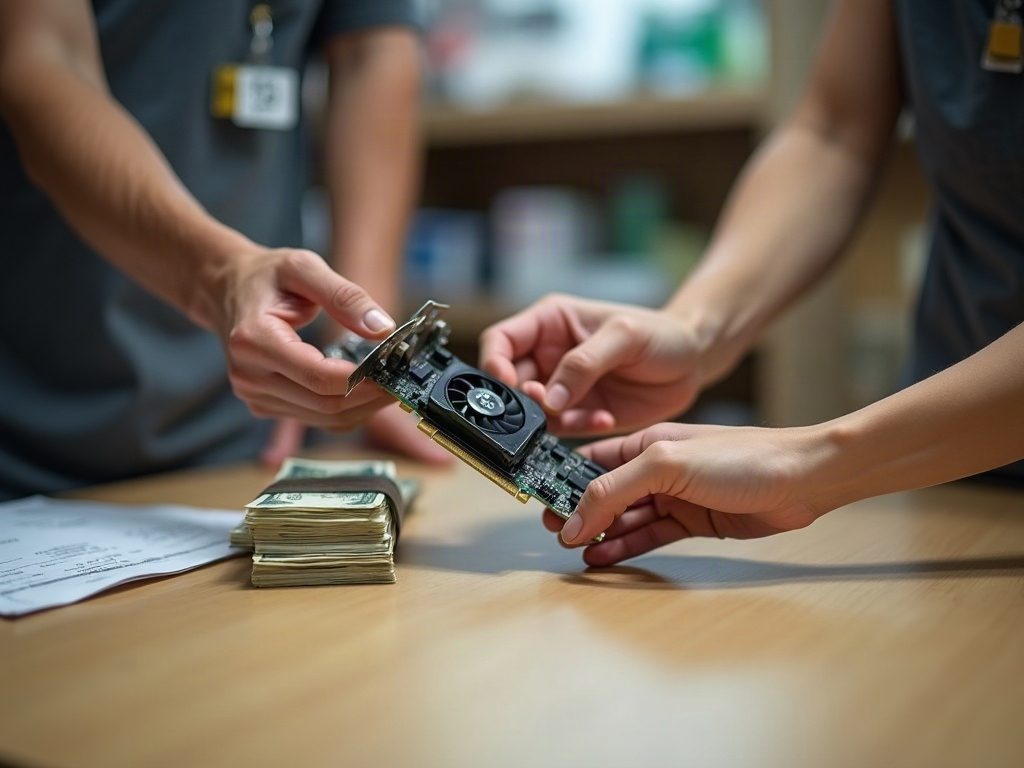
Store credit is not the same as money
A credit that only spends in one shop is worth what that shop charges. If their prices are higher than elsewhere, part of the headline trade-in figure quietly goes back to them at the till.
Credit also tends to expire, and it rarely comes out as cash if you change your mind. None of that makes trade-in wrong — but the figure on the screen and the value in your pocket are two different numbers, and only one of them is comparable to a cash offer.
How automated quotes work
Most trade-in programs quote from a dropdown before anyone has seen the item. That is quick, and it has a predictable consequence.
-
The categories are coarse
One entry often covers several configurations, so the quote describes a class of item rather than yours.
-
Condition is self-assessed
You grade it, then somebody else regrades it later, and the second grade is the one that counts.
-
The revision arrives after they have it
Same asymmetry as posting to an online buyer — the item is with them when the offer changes.
What a specialist buyer does differently
The honest summary is that we look at the actual item and we know what it is.
-
A person who knows the hardware
The difference between two cards with the same name and different memory is the sort of thing that moves the price, and a dropdown does not ask.
-
Priced on what it is selling for used
As a percentage, updated weekly — with condition and demand moving it from there.
-
Cash or company check, same day
Spendable anywhere, expiring never.
-
The quote comes first
A quote online before you drive, confirmed in person, and you can decline and take the item home.
Where trade-in genuinely wins
If you were already buying something from that retailer, and the credit covers it, and the item is a current mainstream model their system prices well — take the trade-in. That is a real scenario and it is not worth pretending otherwise.
It stops making sense when the hardware is older, unusual, or a component rather than a whole device. Those are the cases a dropdown handles worst and a specialist handles best.
Loose components — cards, processors, memory, drives, motherboards — are mostly outside what trade-in programs accept at all. They are the core of what we buy.
Worth checking before you accept either
-
Is it cash or credit
And if credit, where does it spend and when does it expire?
-
Who inspects it, and when
Before or after it leaves your hands?
-
What happens if the offer is revised
And who pays to send it back?
-
What happens to the data
On any drive included, and do you get that in writing?
Every drive we buy is securely erased at no charge, with a printed certificate on request. What it documents →
Common questions
Do you offer store credit?
No. Cash or company check, the same day. There is nothing to spend credit on here — we buy hardware, we do not sell it retail.
Will you beat a trade-in quote?
Sometimes, particularly on components and older hardware, and sometimes not on a current mainstream device a retailer is promoting. Call with the model and we will tell you which it is.
Do you take trade-ins against a repair?
Buyback Geeks buys hardware for cash. Anything involving repair work is a separate conversation — ring (210) 710-2020 and ask.
Can I sell just one component?
Yes, and that is most of what we do. A single graphics card, processor, memory kit or drive is a normal visit.